A familiar question on the internet is “can a person survive on beans and rice?”. Naturally, that is a question near and dear to the heart of Yumbini. So, let’s take a look!
Thrive or Survive?
Humans are extremely adaptable. This is obvious from the huge variety of foods and cuisines around the world. All very different, yet humans are clearly surviving.
But most of us hope to thrive, not just barely survive. For that you need adequate amounts of all the necessary nutrients. It’s hard for one single food to accomplish this. That’s why dietitians recommend eating a variety of foods. But let’s see how close beans and rice can get.
Rice and Beans or Beans and Rice?
Most everyone knows beans and rice are good for you. But not all beans and rice are created equal. Some packaged products (and some recipes) are mostly rice with only a few beans speckled in.
Rice tastes great with beans, and enhances the “protein quality”. But it’s beans that are the heavy hitters. They contribute most of the protein, fiber, vitamins and minerals. That huge health benefit is why Yumbini intentionally has more beans than rice.
Okay so with Yumbini, can you survive on beans and rice?
All Yumbini Diet?
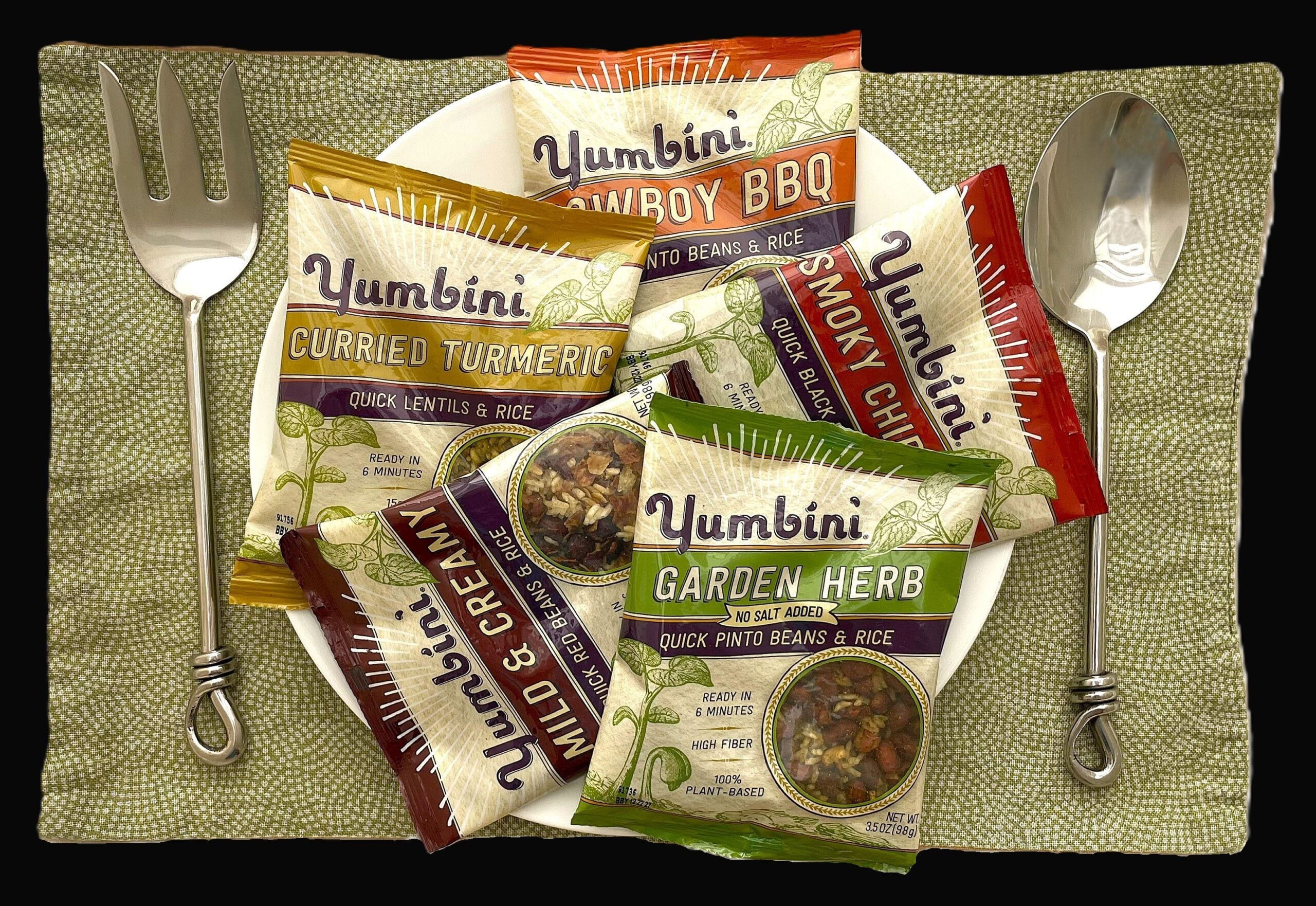
Most people need to eat about 2000 calories a day. To get that many calories, a person would eat 5 packages of Yumbini every day. Convenient because Yumbini comes in 5 flavors!
I calculated the nutrition facts for eating one each of the 5 Yumbini flavors and it looks like this:
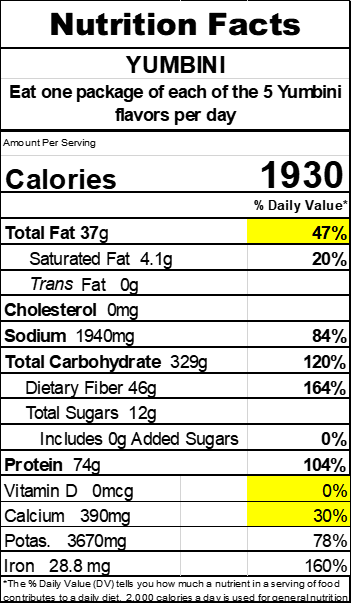
As you can see, the “All Yumbini” diet provides plenty of protein, and a ton of fiber and iron. And not too much of the bad stuff like saturated fat and cholesterol. The yellow shading shows necessary nutrients that are less than 50%DV. Of these, I think calcium is the only one to worry about. Here’s why.
Let’s start with fat. Humans need some fat in their diet, but a low fat diet is not necessarily a bad thing. And because all the fat in Yumbini is unsaturated vegetable (sunflower) oil, this level of fat is probably not a problem. (See more here.)
What about Vitamin D? Vitamin D is not commonly found in foods. It is only present in fatty fish and some dairy products. But that doesn’t usually matter because our bodies make Vitamin D for us when our skin is exposed to sunlight.
So, the main issue is Calcium. But how does the all Yumbini diet compare to other “survival” diets?
All Potato Diet?
I asked my friendly AI-bot for the best single food to eat for survival and, somewhat surprisingly, it said white potatoes.
Here is the nutrition profile of 2000 calories of (baked) white potatoes:
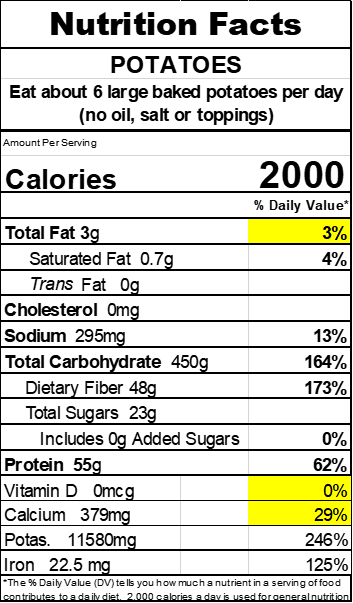
Look at that! The optimum “all potato” diet is low in the same three nutrients as the “all Yumbini” diet!
But in the case of plain potatoes, the fat content is so low, it is likely to cause problems. According to Harvard, fat in the diet “supports cell growth, keeps cholesterol and blood pressure under control, and helps your body absorb vital nutrients”. Fat can also keep your brain healthy.
Two other nutrients not listed on the standard nutrition facts panel, are Vitamin C and Vitamin A. Here potatoes have the advantage because they contain significant amounts of Vitamin C. And while both white potatoes and Yumbini contain some Vitamin A, it may not be enough for you to thrive.
And lastly, as with all plant foods, neither white potatoes nor Yumbini provide Vitamin B-12 (which is available only from animal sources).
So, let’s call it a toss-up in the Yumbini vs. white potatoes competition. Potatoes have Vitamin C, but Yumbini has more protein and fat.
How to Thrive AND Survive on Beans and Rice
Okay, to answer the question, can you survive on beans and rice? Yumbini beans and rice: yes, you can survive. But not forever.
Fortunately, to take Yumbini from survive to really thrive (and get ALL the nutrients you need), is easy! Just add some of the following to your Yumbini:
- Green leafy vegetables, broccoli or dairy for calcium
- Yellow vegetables like carrots or squash for Vitamin A
- Fruit, bell peppers or potatoes for Vitamin C
- Get outside in the sun every day for Vitamin D
- Take a supplement for B-12 (if you are vegan)
Sound familiar? Yumbini plus fruits, vegetables and sunshine! Sounds pretty good, doesn’t it? And way better than eating potatoes all day!
If you need menu ideas, we have lots of recipes for inspiration. Please check them out. And may you THRIVE (not just survive on beans and rice)!!
Notes:
Potatoes vs. Sweet Potatoes
Some will argue that sweet potatoes are better for you than white potatoes. I compared the nutritional profiles. There are advantages to both. Sweet potatoes contain more calcium, fiber, sugars, vitamin C and a crazy amount of vitamin A. On the other hand, white potatoes contain more protein, iron and potassium. Best is probably a combination of both. But you would still lack calcium, fat, vitamin D and B-12.
For an unexpectedly fascinating history of potatoes, read Michael Pollan’s book Botany of Desire.
Nutritional Reference
Reference for potato nutrition information: USDA FoodData Central.
PDCAAS
Plant based proteins use a PDCAAS value to adjust the percent daily value for protein digestibility. PDCAAS values vary widely with product preparation. For Yumbini, we use a conservative PDCAAS value of 0.71. And for potatoes, I used 0.56 as reported by this study.