

A familiar question on the internet is “can a person survive on...
Read More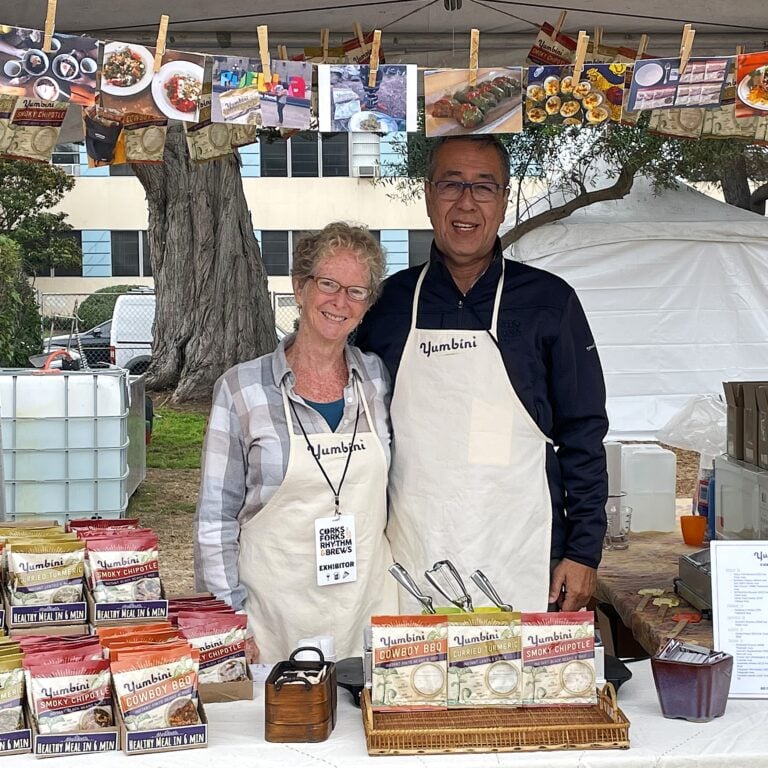
We are a woman-owned business based in Oakland, California (read more about being a woman-owned business here). Yumbini is the brainchild of Certified Food Scientist, Jan Matsuno; the culmination of a lifetime of food fascination and a 40-year food industry career. Jan is joined by Aki, her husband and Yumbini taster, who expertly handles sales.
 Prior to launching Yumbini, Jan held senior product development positions at Del Monte, Safeway, Mindful Food Consulting, and CCD Innovation, creating thousands of new food products for the US and countries around the world.
From an early age, Jan had imagined inventing a food to solve world hunger. She loved to experiment in her home kitchen, developing foods with health benefits. Eventually, her years of experience enabled her to create the perfect quick meal: Yumbini 6-minute beans and rice! Delicious, healthy, plant-based, shelf stable, gentle on the planet, affordable, and ready in a hurry.
Jan realized it was time to give back. If there were ever going to be convenient, shelf stable, healthy meals for folks on a budget, she was going to have to launch them herself. In 2022, Yumbini was born!
Jan is a proud graduate of Oregon State University, a member of the “inaugural class” of Certified Food Scientists credentialed by the Institute of Food Technologists, and appeared in Morgan Spurlock’s movie Super Size Me 2: Holy Chicken as the laughing food scientist.
Shortly after launch in 2022, Jan’s husband, Aki, seeing the potential for Yumbini, came out of retirement to manage sales. This was a huge boost for the business because Aki’s 40-year career in food sales and marketing complements Jan’s science and production background perfectly. Even better, he has a salesman’s ability to quickly calculate margins and profits in his head!
Aki has held senior sales and marketing positions at Kikkoman, Nissho Iwai American Corp. and Mizkan Americas in both Asia and the US. He has managed accounts and developed business in Japan, Singapore, all of North and South America and even Russia. He has extensive experience selling and promoting a variety of food products from wine, soy sauce, vinegar, and salad dressing to organic products, food ingredients – and now quick beans and rice!
Aki has a degree in Agricultural Economics from Kyushu University in Fukuoka, Japan with special training at the Institute of International Study and Trade in Shizuoka, Japan. He keeps saying he is going to retire again, but he’s obviously having too much fun.
Yumbini’s mission is to provide convenient, healthy foods, that are mindful of the earth’s resources and accessible to everyone, with the power to transform our health, our lives and our world.
Yes! Our State of CA Small Business Certification number is #2029755.


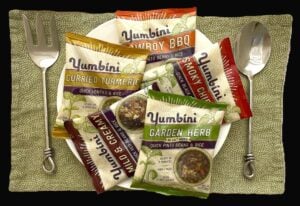
 Yumbini is dry, shelf stable, quick-cooking beans and rice. Easy to make and ready in 6 minutes – everything is there, all you need is water! One pouch makes a satisfying serving (about a cup and a half). It is meant to be a meal for one or a side for two.
Yumbini is carefully crafted from natural ingredients, featuring the overwhelming goodness of beans and lentils. These nutritious powerhouses, combined with rice and seasonings, make it high in fiber, low in saturated fat, and filled with 14-15g protein; all without added sugar, preservatives, MSG, gluten, “big 9” allergens, or too much salt.
Great for a quick lunch, dinner or even breakfast. Yumbini comes in four fabulous flavors inspired by favorite bean and rice combinations around the world. Each is perfectly seasoned; fantastic as-is, or paired with other ingredients.
- Smoky Chipotle Black Beans and Rice
- Curried Turmeric Lentils and Rice
- Cowboy BBQ Pinto Beans and Rice
- Mild & Creamy Red Beans and Rice
- Garden Herb NO SALT ADDED Pinto Beans and Rice
Nothing complicated, just real food for everyday busy people.
To learn more about how we got started, take a look at our blogs The Instant Ramen of the Health Food World, Shout Out from my Alma Mater, Oregon State!, and We’re on the Cover of a MAGAZINE!
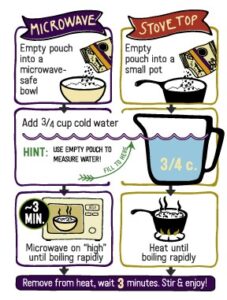 Yumbini is yummy and beany – and FAST! In fact, it was designed to be as fast and easy as instant ramen,
Just empty the pouch of Yumbini into a bowl or pot, add 3/4 cup tap water, bring to boil (microwave or stovetop) and cool three minutes.
You can even measure the amount of water needed in the empty pouch! Carefully open the pouch as shown, pour out the Yumbini, hold by the circle, and add water up to the line.
For even more, please read our blog Prepare Yumbini – there are so many easy ways!
You can add boiling water to Yumbini (in a heat proof container), but it will take much longer for the water to soak in – about 15-20 minutes. If you use this method, remember the food safety rule of keeping hot foods hot and cold foods cold. So devour it right away or store in the refrigerator for later.
If you are traveling, and want to eat your Yumbini later in the day, try making it in a Thermos to keep it hot. Read this blog to learn how. Or check out How to Make School Lunch with Yumbini to see the Thermos method step by step.
Please remember, the Yumbini bag is NOT heat-safe. Do not pour hot water into the bag. And do not eat Yumbini without cooking.
The beans and rice in Yumbini are pre-cooked and dried again. So when you prepare Yumbini at home (or at the office, or campsite), you are just heating it and soaking the water back up.
People often ask if Yumbini is freeze dried. The answer is no. Yumbini is air dried, similar to what you would do in a home dehydrator. This method is simpler and less energy intensive than freeze drying. And it works great for producing full flavored beans and rice that are shelf stable without preservatives!
The term “processed food” is confusing. It is true that some processing removes important nutrients, or adds too much salt or sugar to foods. But on the other hand, most food processing, such as cleaning, drying, freezing, canning and cooking, makes food safer, taste better and last longer.
To learn more, see Why the World Needs Processed Food, and “Ultra Processed Food”: More to the Story.
Yumbini contains only dried beans, rice, vegetables, sunflower oil and seasonings. No added sugar, and a carefully controlled amount of salt. Drying is probably the oldest food preservation method on earth. The only thing taken away is water, leaving the nutrients behind. But taking out that water means the microbes that cause food spoilage cannot grow (they need water to live just like you!). The result is a lightweight, super stable, take anywhere, yummy, heathy meal! Go Yumbini!
Yumbini was specifically developed so it can be eaten by everyone. We are very proud of our strict product standards. All Yumbini products must be:
- In compliance with Whole Foods Food Ingredient Quality Standards
- Low in Saturated Fat (1g or less per serving)
- 480 mg sodium or less per serving
- No animal-derived ingredients
- No added sugar
- No preservatives
- No artificial flavors, colors or MSG
- No genetically modified ingredients
- No gluten
- No “big 9” allergens (milk, eggs, fish, crustaceans, wheat, soy, peanuts, tree nuts, sesame)
Yumbini is proudly made in California, USA.
Yes! Yumbini is gluten-free.
Gluten is found naturally in wheat, barley, rye, triticale and related grains. To learn more see Gluten: The Protein We Love to Hate.
There is no gluten in beans or rice, or any of the other ingredients in Yumbini. In addition, our processing facility has strict allergen policies and procedures to avoid cross contamination. Yumbini is not third-party certified gluten free. This is because we feel it is more important to keep product costs low (and pass savings on to you).
No! All the ingredients in Yumbini (besides the sunflower oil) are dried. Drying is probably the oldest food preservation method in the world. The only thing taken away is water, leaving the nutrients behind. But taking out that water means the microbes that cause food spoilage cannot grow (they need water to live just like you do!). And if you are wondering about the sunflower oil, it doesn’t contain any water to begin with. So no preservatives are required!
Yumbini was purposely designed to be eaten by everyone.
Because of that, it does not contain any of the “big 9” allergens (wheat, soy, milk, eggs, fish, crustaceans, peanuts, tree nuts or sesame).
Our processing facility also does not handle any of the “big 9” allergens. So there is no chance of cross contamination.
No, we do not use any genetically modified ingredients, and confirm this with our suppliers.
New “genetically modified organisms” (GMOs), also called “bioengineered” (BE) ingredients (plants and now animals too) are being developed all the time. But there may not be as many as you think. The list of GMO food crops (maintained by law by the USDA) contains only 14 items. You can see it and learn more here.
You may be interested to know that as of January 1, 2022, food manufacturers are required to label foods that contain GMO/BE ingredients. But be aware that this information may not be obvious. It can be shown on the label using words, symbols, a scannable link (like a QR code), text message instructions, phone number or web address. Learn more here.
No, Yumbini is not certified organic. We certainly support organic agriculture. It protects our environment from chemical fertilizers and pesticides. But it is also expensive and restrictive. Because Yumbini was intentionally created to provide healthy convenient food for every day people on a budget (the ramen-eaters in all of us!), it is purposely not organic to keep the price as low as possible. Read more about this in our blog Would Organic Make it Better?
On the other hand, we also made Yumbini as inclusive and accessible as possible. So it does not include any wheat, gluten, “big 9” allergens, animal products, preservatives, MSG, artificial, or GMO containing ingredients.
Fortunately there is a lot of research being done now on sustainable land systems – both organic and conventional. All farmers have a key role to play in rebuilding soil, sequestering carbon and mitigating climate change.
Canned beans are a wonderful invention. Extremely nutritious and convenient. They have a place in every kitchen.
BUT they don’t taste as good as cooking beans yourself from dry. Some may attribute this to the can itself. But the flavor difference is mostly from the high heat needed for sterilization, and food additives (calcium chloride, EDTA, etc.) added to canned beans to improve color and texture.
The beans used in Yumbini have none of that! They are pre-cooked using a patented process somewhat similar to what you do at home. Steam is used so flavor, color and nutrients are not lost in cooking water. Then the cooked beans are dried again so they are shelf stable.
What that means for you is delicious, home cooked flavor, and optimal nutrition!
What a great question! Kids love beans and rice and want food FAST, so Yumbini is a perfect fit. As to which flavor, if you want to minimize salt, consider Garden Herb (NO SALT ADDED). It has a mild herby flavor and absolutely no added salt.
For toddlers on up, start with Mild & Creamy. Its mild, savory flavor and mashed beans give it a soft, soothing comfort food texture. We’ve hardly found a single kid who doesn’t like it!
Next up would be Cowboy BBQ. It tends to be another kid favorite because of the slight sweetness (from apples – no sugar!). Besides the sweetness, the spices in Cowboy BBQ are similar to mustard and ketchup which are familiar flavors for most kids.
Then, depending on the kid, some like the spiciness of Curried Turmeric and Smoky Chipotle. At demos, we tell kids these two taste like Indian food or a spicy burrito. Some older kids will say “I want to try the burrito (or Indian food) one”!
Another good thing about kids and Yumbini, is that many of them can make it themselves in the microwave. Click here for tips on making sure this is a success (for them and for YOU!).
And for anyone making Yumbini for school lunches, please read How to Make School Lunch With Yumbini.
That is a great question, and the answer is “it depends”! You have probably heard a lot about the virtues of fresh fruits and vegetables. And it is true that fresh produce, right off the farm, in peak season, can’t be beat. On the other hand, we also know fresh fruits and veggies are highly perishable.
That means they start losing their good color, flavor, texture and nutrients as soon as they are picked. And it can be a long journey from the farm, to the store, to your refrigerator, to your Yumbini! On the other hand, canned and frozen vegetables are processed within hours of harvest so the nutrients and flavor are “locked in” until ready to eat. That makes them super convenient and a great choice!
The biggest key to remember is that eating some vegetables (any kind!) is better than no vegetables. And Yumbini is a great friend to forgotten vegetables everywhere. No matter what you have available, it can taste great with Yumbini – so frozen, fresh or canned – don’t feel guilty! Read more about this here. And for Yumbini vegetable combination ideas, take a look at our Recipes page.
White rice. The rice that goes into Yumbini is pre-cooked and dried so it can be ready for you in a jiffy when you are hungry. Brown rice just can’t do that. Also, brown rice has a short shelf life which would make Yumbini quickly taste stale or rancid.
But you can relax because the main reason to eat brown rice instead of white is the added fiber. Fortunately, Yumbini contains a LOT of fiber (more than a quarter of what you need for the day) from the beans and lentils. So relax, you’re covered!
Learn more about fiber and your microbiome in the two blog posts here and here.
You certainly can enjoy Yumbini with meat. But there is plenty of healthy plant protein in Yumbini already, And most Americans need to eat more vegetables (instead of more meat) for optimal health. We try to make veggies convenient, fun and delicious!
Yumbini, after cooking, should be the texture of tender, properly cooked rice and beans mixed together. When preparing, be sure to heat until boiling rapidly and allow to stand at least 3 minutes after cooking. If it is too watery and/or crunchy, wait another minute to cool and absorb water. You can also microwave another 30 seconds-1 min if needed.
If your Yumbini comes out a bit dry, feel free to add a little extra water. Remember, microwaves vary so you may need to adjust cooking time for best texture. When cooking, the Yumbini should come to a full bubbling boil, but not “cremate!”
When preparing Yumbini on the stovetop, once it boils, turn off the heat and wait 3 minutes. You don’t have to keep boiling for 3 minutes.
For more suggestions read our blog Yumbini might be ready sooner than you think!
Citric acid is naturally occurring in many fruits, most notably, and not surprisingly, citrus fruit as well as strawberries. Small amounts are also formed by the human body as you metabolize (digest and use) food. The citric acid we use has been produced by natural fermentation. Following fermentation, it is highly purified and certified by the United States Pharmacopeia (USP) which verifies the quality, purity, strength and consistency.
Citric acid, like all acids, tastes tart or sour. It is used in Yumbini to improve flavor. Citric acid is sometimes confused with ascorbic acid, which is another word for vitamin C. Unlike ascorbic acid, citric acid is not an essential nutrient for your body. But it does serve to make many foods more delicious and enjoyable!
Yes we do. We are proud to have supported the following organizations with donations of Yumbini:
- Alameda County Community Food Bank (see: Food Bank: Yumbini to the Rescue!)
- Oregon State University Honors College (see: Yumbini For Hungry College Students)
- Alameda Boys and Gilrs Club (see: Yumbini Parties for a Cause in Alameda!)
- Hurricane Helene Relief (see: Yumbini Love: 224 Meals for Hurricane Helene Relief)
- Pasadena Community Job Center (see: Sending Love for LA Fire Relief)
- Peralta Hacienda Historical Park (see: Stay Strong: Every Human Being Makes History)
- Women’s Wilderness
If you are interested in a donation, please contact us.
You might also enjoy this blog Hungry People Are All Around Us about ways to support our communities

 Beans, peas and lentils (also called legumes or pulses) are a great source of plant-based protein, fiber, iron and other vitamins and minerals. They have a low glycemic index so they can prevent blood sugar spikes or lows (see our blog Yumbini Takes on the Glucose Challenge.)
As you can read in Something simple to help fight disease: Legumes, research has shown that whole food plant based diets (including lots of beans and lentils) can prevent and even reverse many chronic diseases like heart disease and type 2 diabetes.
And you you don’t have to go 100% over to a whole food plant based diet to get benefits. ANY progress or movement in that direction will help treat chronic disease. In other words, if you can only eat legumes once a week (Yumbini can help!), it is better than not at all.
Beans are so beneficial to health that the US Dietary Guidelines Committee, after 22 months of study, had only one recommendation. Diets that emphasize “beans, peas, and lentils while reducing intakes of red and processed meats”. You can read all about it in our blog Big News Beans are the New Superfood.
Even the United Nations has recognized the importance of beans by establishing February 10 as World Pulses Day. The day highlights the “fundamental role pulses play in promoting better nutrition, a better environment, and a better life, leaving no one behind.” Our blog For the Love of Beans, it is World Pulses Day! describes even more benefits of peas, beans and lentils.
And if you are still not convinced, read Miracle of Beans and Lentils, and What if Love (and Beans) Really IS All You Need?
Sometimes the term “plant-based” conjures up foods like oat milk or vegan sausages. These foods are made using plant proteins and other processed ingredients to imitate the taste of animal products.
Yumbini is not like that at all! When we say Yumbini is plant-based, we mean it does not include any animal products. No beef or chicken broth, no egg, no dairy. It is made very simply with only beans, rice, oil and seasonings (like spices and dried fruits and vegetables).
We created Yumbini this way for two reasons. First, we wanted everyone, vegans, vegetarians and carnivores, to be able to eat and enjoy Yumbini. Second, there is no need to add animal derived ingredients to Yumbini! It tastes great and has an impressive nutritional profile just as it is. After all, beans and rice is the original comfort food for many cultures around the world!
For more, read Is Beans and Rice a Complete Meal? and Easy Comfort Food – Calm With Beans and Rice.
 Whether you choose to be vegetarian, vegan or just cut back on meat, eating more plants will benefit your health.
Reasearch by the American College of Lifestyle Medicine shows “overall diet quality is the leading single cause of premature death in America. Optimal nutrition is essential to the root-cause treatment of chronic conditions.” They recommend eating mostly “minimally processed vegetables, fruits, whole grains, legumes, nuts, and seeds”. In other words, plants, plants, and more plants!
To learn more about lifestyle medicine, see this article about various diets, and this one about the “dietary spectrum”.
Plant -based diets are associated with increased consumption of vitamins and minerals, improved heart health, decreased risk of cancer, and improved blood glucose management. Eating plants also supports your immune system, reduces inflammation and helps maintain a healthy weight.
The more different colors, shapes, sources and forms of plants the better! And remember, only plants have FIBER! Best of all, the main plants in Yumbini are truly miraculous legumes – read more about them here.
And if THAT is not enough to convince you of the value of plants, eat like a Ninja! Check out or blog: Do You Know the Reason Ninja Were Vegetarians? Need we say more?
Remember, if you decide to skip animal foods altogether, it is important to take a vitamin B-12 supplement.
Many prepared and instant foods are very high in sodium – some even as high as 1700mg per serving. That is almost enough for a whole day!
Fortunately, Yumbini is carefully seasoned with plenty of spices, vegetables and fruits instead of tons of salt. One big bowlful contains only 480mg sodium (about one fifth of what is recommended per day). And if you don’t think Yumbini is salty enough, you can always add more!
The “Dietary Guidelines for Americans” recommend that everyone limit foods high sodium. Eating too much sodium (salt) is associated with high blood pressure, heart attack, and stroke. Read more in our blog about controlling your salt consumption.
And for anyone wanting to restrict sodium further, we have Yumbini Garden Herb NO SALT ADDED Pinto Beans and Rice. It has absolutely no salt added so you can modify it as you wish!
Yumbini is full of fiber – at least a quarter of what you need in a day!
You have probably heard that fiber is good for “gut health”, but what does that mean? Fiber actually helps your whole body! It serves as food (prebiotics) for the microbes that live in your intestines (your “gut microbiota”). Read more about fiber and your gut microbes in Make The “Personal Pets” In Your Gut Happy! and Nutrition: Making Your Gut Feelings All Happy.
It also helps you feel full and satisfied. Eating more fiber is linked to lower body weight, and lower risks of cardiovascular disease, and diabetes. Scientists have even found that your gut communicates with your brain, so if your gut is happy, you are happy! A healthy gut is associated not only with optimal health, but even improved mental health and longevity! This blog Yes, You Do Think With Your Gut, has more.
Most people don’t eat enough fiber. In fact, it is classified by experts as a “nutrient of public health concern“. But Yumbini makes getting enough fiber easy! You will get up to 32% of your daily requirement of fiber in just one delicious serving – even more if you add veggies. What are you waiting for?
Yes it is low in saturated fat!
Nutrition experts recommend Americans avoid foods high saturated fat. Generally saturated fat comes from animal sources and unsaturated fat comes from plants. While nutrition science is often confusing, saturated fat has been associated with higher cholesterol and heart disease.
Some studies have even found that replacing saturated fat with unsaturated fat in your diet can reduce your risk of heart disease by about the same amount as cholesterol-lowering drugs!
Lucky for you, unlike instant ramen or macaroni and cheese, Yumbini is low in saturated fat because it is made with sunflower oil.
Yes, it’s true. Unlike some canned beans, and lots of bean recipes, Yumbini has zero added sugar. No fake sweeteners either – only whole fruits and vegetables!
Most people have heard by now that eating too much sugar is bad news. It can promote obesity, diabetes and heart disease. Excess sugar consumption has also been linked to acne, cancer, and depression, not to mention tooth decay!
Some may think that artificial sweeteners are the solution, but we don’t agree. As you can read in our blog Sugar Substitutes Are Out (but in Everything), it is important to read labels carefully. Nutrition experts agree, it is best to enjoy the natural sweetness of fruits and vegetables (like in Yumbini!) and enjoy treats in moderation. See more tips in Sweet tricks to cut down on sugar.
Yes! Two other important nutrients Yumbini provides are potassium and Iron. Potassium, in addition to fiber, has been identified as a “nutrient of public health concern” because most people don’t get enough. Not eating enough potassium can increase blood pressure, deplete calcium in bones, and increase the risk of kidney stones.
Iron on the other hand, is a critical component of hemoglobin in your blood. It enables your red blood cells to carry oxygen from your lungs to the rest of your body. Some people who do not eat animal protein don’t get enough iron. Fortunately, thanks to all those beans and lentils, Yumbini has tons of iron! One package contains at least 30% of what you need in a day.
We add a small amount of sunflower oil to Yumbini to improve the texture and flavor. It is a special kind of sunflower oil called “high oleic”. We use this type of oil for several reasons.
First, it has a mild neutral flavor that does not overpower the spices. It is non-GMO, meaning it was developed through traditional breeding methods, not biotechnology. And it naturally has a long shelf life so we don’t need any preservatives to keep it from going rancid.
All fats are made up of different combinations of “fatty acids” (saturated, monounsaturated, polyunsaturated). Generally fats high in saturated fatty acids are solid at room temperature. And fats high in mono and poly-unsaturated fats are liquid at room temperature. Saturated fats mostly come from animals and unsaturated fats mostly come from plants.
As you can see from this chart, the fatty acid composition of high oleic sunflower oil used in Yumbini is mostly unsaturated and very similar to olive oil.
But it’s a seed oil. Is that bad? In the November 2025 Tufts Health & Nutrition Letter, top nutrition scientists addressed this question. They conclude that while seed oils (AND other oils) are highly processed, there is no evidence this harms human health. Besides that, research shows seed oils do NOT cause oxidative stress, inflamation or increase the risk of disease.
On the other hand, diets high in saturated fats (like butter and other animal fats) have long been associated with increased risk of heart disease. And replacing just 5% of calories from saturated fat with polyunsaturated fat reduced the risk by 15-20%.
The Tufts article concludes “there is plenty of evidence that choosing fats high in unsaturated fatty acids in place of fats high in saturated fatty acids is a healthy choice”.
First of all, passing gas is normal; a sign that your body is working as it should.
This informative article from the Bean Institute explains that fibers from beans are “fermented by beneficial bacteria” in the colon. “Gas is created during this fermentation process. It’s a good sign, one that says these healthful bacteria are being fed well, maintained, and enhanced…which in turn may lead to the prevention of diseases of the gut, as well as other organs in the body.” These types of fibers are called prebiotics.
Studies show what while some people may experience increased gas when first eating beans, this subsides after a few weeks. So, the key is to start slow and gradually eat more beans as your body adjusts. Drinking extra water may also help.
But what about the smell? In this hilarious article by the ever-entertaining Dr. Greger, he points out that the smell usually comes from eating sulfur-rich foods such as meat and eggs. In fact, “researchers found that meat-eaters generated as much as 15 times the (smelly) sulfides as those eating vegetarian”. So again, all guidance points toward eating more beans, not less! (By the way, the Ninja of Japan figured this out long ago, see: Do You Know Why Ninja Were Vegetarians?)
If you are worried about eating Yumbini, start with ½ package and work your way up. Your body will adjust and feel so much better, you will forget all about any gas!
Read more here about the Miracle of Beans and Lentils, the benefits of fiber, and how that fiber can even influence your mood.
We strongly recommend using stainless steel, cast iron or carbon steel cookware. This is especially important when frying and sauteing. Nonstick pots and pans can seem convenient at first, but they are not best for health. No only does the nonstick coating scratch off into your food, but the coating can release harmful chemicals when exposed to high heat (like your stove!).
Old non-stick pans, that you might have gotten from your grandma or the thrift store are, unfortunately, the worst (because the non-stick coatings used in the past were found to be harmful and are not permitted in new cookware). Learn more about how to protect yourself here, here and here. Read our blog on this subject here.

Shout Out from my Alma Mater, Oregon State!
I am thrilled to have been interviewed by the Oregon State University...
Read More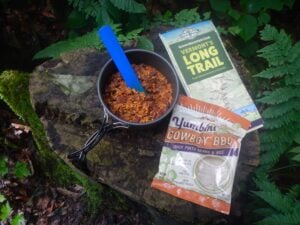
Solo Hike on the LT – One Woman’s Amazing Story
Note: special thanks to Elizabeth Smith for sharing her amazing story with...
Read More
Donating Camping Food to Educate Body and Mind
More than a year ago, in April 2025, I received the following...
Read More